… and That’s Now Their Problem Too
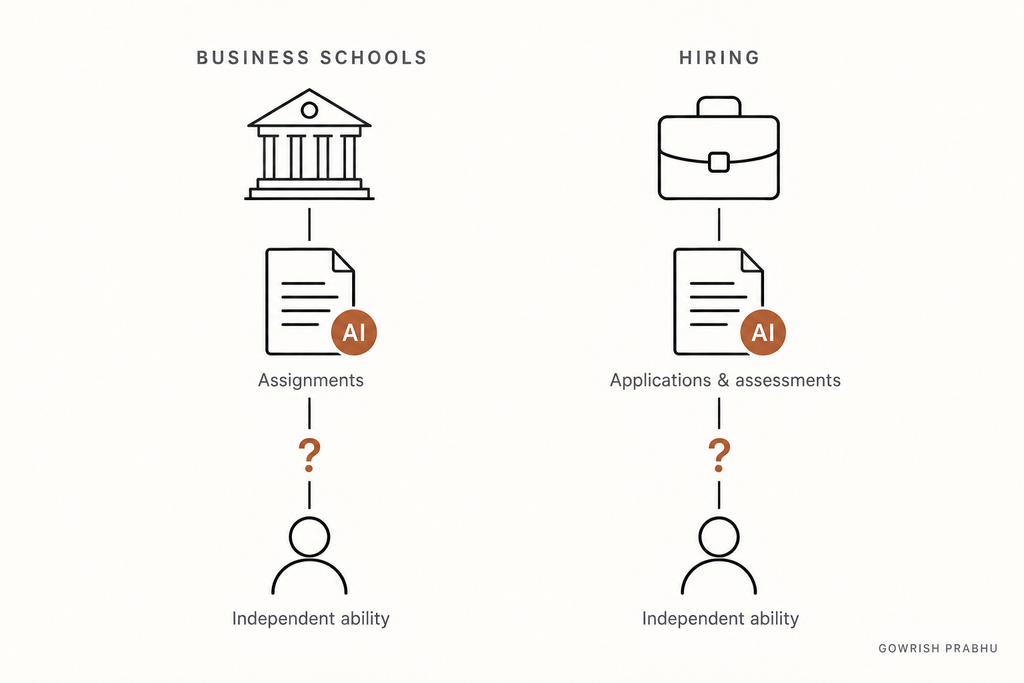
Business schools are not the only institution whose evaluation instruments have lost validity in the AI era. Hiring functions have the identical problem, one step downstream.
The credential and the capability have come apart
For as long as structured hiring has existed, a candidate has been judged based on a few artifacts that she presented during the process i.e., a well-written cover letter, a strong take-home case study, and a confident answer to a behavioural interview question. These have served as reasonable proxies for the underlying capability a role requires. The proxy worked because producing a good artifact was difficult without the capability behind it.
That proxy relationship is now unreliable in exactly the same way, and for exactly the same reason, that a business school case memo is unreliable: the difficulty of producing the artifact has collapsed while the difficulty of possessing the underlying capability has not moved at all. A candidate can walk into an interview extremely well prepared, using AI tools to rehearse likely questions and construct sharp answers, and that preparation can be entirely disconnected from whether they can perform the actual job once hired. Recruiters have started naming this directly: candidates can use generative tools to arrive at an interview highly polished, and then, once hired, their real working capability does not match what the interview process indicated.
Does the hiring exercise sound like acting in a movie as a candidate at an interview?
Without the underlying capability it is as performative as the act of acting.
Why this is harder than a simple detection problem
The instinctive response, trying to detect AI-generated content in resumes, cover letters, and written exercises, runs into a problem that education faced first and hiring is now facing on a lag: detection does not scale, does not stay accurate as models improve, and does not actually answer the question a hiring manager needs answered. Even where hiring professionals have a strong hunch a submission was AI-assisted, they report it is difficult to prove, and pursuing that line of investigation consumes time without resolving the underlying uncertainty about the candidate’s actual capability.
There is a second, less discussed failure mode that makes this worse than a simple honesty problem: AI-assisted preparation can obscure genuine strength just as easily as it can manufacture false strength. It is comparatively easy to flag a candidate whose answers seem hollow or inconsistent under follow-up. It is much harder to distinguish a candidate who is genuinely excellent from one whose AI-polished materials happen to describe genuine excellence that is not actually there. The false positive is nearly invisible at the point of hire, and only surfaces months later, in performance, when the tool is no longer helping.
This means the problem hiring functions face is not “how do we catch cheaters.” It is closer to the assessment-validity problem business schools are now confronting: the instruments were built on the assumption that a good artifact required a good capability behind it, and that assumption no longer holds cleanly enough to rely on.
AI-assisted preparation has become pointless in that the candidates often get enabled by only the vocabulary
and end up feeling that if they know the words they also know the concept.
True capability, especially when it is low, manages to remain under wraps until it gets tested on the ground.
The response taking shape
The emerging response mirrors what is happening in business school assessment redesign, translated into hiring terms. Rather than trying to make resumes and take-home exercises more AI-resistant, leading practice is shifting toward evaluation formats that make AI-mediated performance visible rather than hidden: realistic job simulations and structured, in-context work samples that reveal not whether a candidate can produce a good output, but how they think, problem-solve, and use AI tools when the process is transparent about that use rather than trying to prevent it.
This reframing matters because it treats AI fluency as a variable to be observed rather than a threat to be screened out. The stronger emerging practice explicitly assesses prompt construction and iteration, the candidate’s judgment in evaluating and refining AI output, their sense of when AI assistance is and is not appropriate to the task, and their applied judgment when reviewing AI-generated content for errors or blind spots. That is a meaningfully different skill profile than “did they write this resume themselves,” and it is arguably a more accurate predictor of on-the-job performance in a workplace where AI tools are now simply part of the ambient environment, not a novelty to be detected and penalised.
Structured scoring rubrics focused on problem-solving, learning agility, and execution capability, rather than writing polish or interview fluency, are the other half of this shift, for the same underlying reason assessment redesign in education is moving toward process and defence rather than final output: the final artifact has stopped being trustworthy evidence on its own.
Why this should concern hiring leaders more than it currently does
Most organisations are treating this as a screening-technology problem, a question of which AI-detection vendor to buy, or which resume-scanning tool to upgrade. That framing under-responds to the scale of the issue. If the fundamental signal hiring processes rely on has degraded, buying a better version of the same instrument does not fix a validity problem. It just produces a more confident wrong answer.
The organisations most exposed here are the ones hiring at entry level and early-career, precisely because those are the roles where the candidate has the least track record of independent work to fall back on if the interview and resume signal turns out to be unreliable. A senior hire brings a portfolio of prior, verifiable outcomes that can partially compensate for a degraded interview signal. An entry-level hire brings almost nothing except the resume, the take-home exercise, and the interview, which means entry-level hiring is exactly where this problem bites hardest and where the cost of a false positive compounds over the longest career runway.
This becomes challenging in video interviews for senior hires, where , nowadays,
I am always watching whether the candidate is fixed on a spot around the screen (another screen perhaps?) and
how or how much unnatural lag they show after they heard the question.
I insist on face to face no-device interviews, if possible.
There is also a talent-pipeline dimension connecting this back to education. If business schools are simultaneously struggling to certify genuine judgment in their graduates, for the reasons described in the assessment-validity problem playing out in their own classrooms, hiring functions cannot assume the credential itself has closed the gap that the interview process is failing to catch.
Two unreliable signals stacked on top of each other, a degraded academic credential and a degraded hiring process,
add up to a considerably worse problem than either one alone,
and it is the situation many employers are currently in without having fully named it.
The so-what
Hiring functions have spent the AI transition treating this as a candidate-behaviour problem to be policed: catch the cheaters, screen out the AI-generated resumes, move on. The more accurate framing is that the entire evaluative apparatus of hiring, like the entire evaluative apparatus of business education, was built on an assumption about the relationship between effort and output that generative AI has broken. Detection tools chase a moving target and will keep losing that chase as models improve.
The organisations that will still be able to identify genuine capability in candidates are the ones that redesign what they evaluate, toward simulation, transparent AI-assisted work, and applied judgment under observation, rather than the ones still hoping a better filter can restore a signal that the underlying instrument was never built to survive.