Across undergraduate classrooms and executive education programmes alike, a large and growing share of learners are using generative AI to bypass the cognitive work that learning requires, not to accelerate it. A widening body of research converges on the same finding, i.e., AI use correlates with cognitive offloading, and cognitive offloading correlates with declining critical thinking. This is not an argument against AI in education. It is an argument for a specific, disciplined mode of use of AI.
The pattern showing up in the data
For the past few admissions cycles, business school faculty have been describing the same phenomenon in different words: students arrive at conclusions faster and defend them less well. Executive participants submit polished assignments with thinner reasoning underneath. Case discussions move quickly to an answer and struggle to survive a second “why.”
This is not anecdote dressed up as trend.
It shows up consistently in the research literature published over the past eighteen months.
MIT Media Lab’s 2025 study1 is the most cited and the most visceral. Researchers had 54 participants write SAT-style essays using either ChatGPT, a search engine, or no tool at all, while recording brain activity across 32 regions via EEG. The ChatGPT group showed the lowest neural engagement of the three, and underperformed on measures of linguistic ownership and recall of their own arguments, even when the essays themselves were technically competent. The tool produced a good artifact and a hollowed-out author.
Michael Gerlich’s study at SBS Swiss Business School2, published in Societies in January 2025 and covering 666 participants across age groups and educational backgrounds, found a statistically significant negative correlation between frequency of AI tool use and critical thinking performance mediated specifically by cognitive offloading. The pattern was strongest among younger participants, the exact cohort now moving through undergraduate and early-career MBA pipelines.
Microsoft’s 2025 study of knowledge workers3 found the same mechanism operating in professional settings: higher confidence in an AI system’s ability to handle a task predicted lower critical engagement with that task. Efficiency went up. Independent problem-solving capacity, tracked over time, went down. This matters directly for executive education, because it says the crutch behaviour formed in the classroom does not stay in the classroom, ultimately when it does, it walks into the boardroom.
I cite my personal observations here. When given an assignment requiring say five long-form answers, unless strictly limited on output format, a significant minority will create a PowerPoint presentation. GenAI it working hard at both. But here the students fail to catch that I do not want them to simplify the response with pictures and design (here is onus is on me to favourably interpret it in my frame of reference), instead I want them to articulate their thinking in fully thought out breakdown of reason, inference and where needed, the causality (here the onus is on the student and clearly she does not want to exert). Imposing of PowerPoint penalty has been met with mild protests.
None of this is evidence that AI degrades intelligence. It is evidence that a specific pattern of use “delegate the thinking, keep the output” degrades the practice of thinking, in the same way that using a calculator for arithmetic you never learned degrades numeracy, except at a scale and speed we have not previously had to design curricula against.
Why business schools and executive programmes are exposed to this specific failure mode
Two things make this more acute in graduate management education than in most other disciplines.
First, the core output of a business education is not a correct answer. It is judgment under ambiguity, the ability to reason through incomplete information, weigh competing stakeholder interests, and defend a position that a smart person in the room disagrees with. A generative model is extremely good at producing a plausible-sounding answer to an ambiguous business question. It is not able to develop the learner’s own judgment by doing so, and a learner who submits that answer as their own has practiced only the prompting.
Second, executive learners are under acute time pressure and are evaluated, unlike traditional undergraduates, on decisions they will make with real capital shortly after the programme ends. That combination: time-starved, high-stakes, immediately applicable, makes the crutch use case genuinely attractive in the short run. A partner at a case competition or a participant finishing a module between board meetings has every rational incentive to let the model finish the case memo. The cost of that shortcut is invisible until the judgment it should have built is needed live, unassisted, in a negotiation or a capital allocation decision or marketing operation design, and by then it is too late to notice the gap was there.
This is the crux of the argument: the risk is not that learners use AI.
It is that the default mode of use — fast answer retrieval —
is precisely the mode least suited to what management education is supposed to build.
What a different mode of use looks like
The emerging research on AI-assisted tutoring points to a workable alternative, and it is not “use AI less.” It is “use AI differently.”
Socratic-tutor implementations studied extensively through 2025, including a Frontiers in Education comparative study of ChatGPT-based Socratic dialogue4 against human tutors — role-engineer the model to withhold the answer and instead question, scaffold, and force justification. The research finding that matters most for programme design: AI-supported Socratic dialogue produced measurably greater learning gains than unassisted study, particularly for learners who lacked access to one-on-one tutoring, precisely because the model was constrained from doing the thinking for the student. Same tool. Opposite instruction to the tool. Opposite outcome.
Translated into a working distinction for learners and faculty, the difference is this:
Crutch use treats AI as an answer engine: ask the question, receive the output, submit it. The learner’s cognitive involvement ends at the prompt.
Enabler use treats AI as a sparring partner: draft your own position first, then use the model to attack it, stress-test its assumptions, surface the counterargument you didn’t see, and generate the alternative framings a sharper peer would have raised in the room. The learner’s cognitive involvement is heaviest after the model responds, not before.
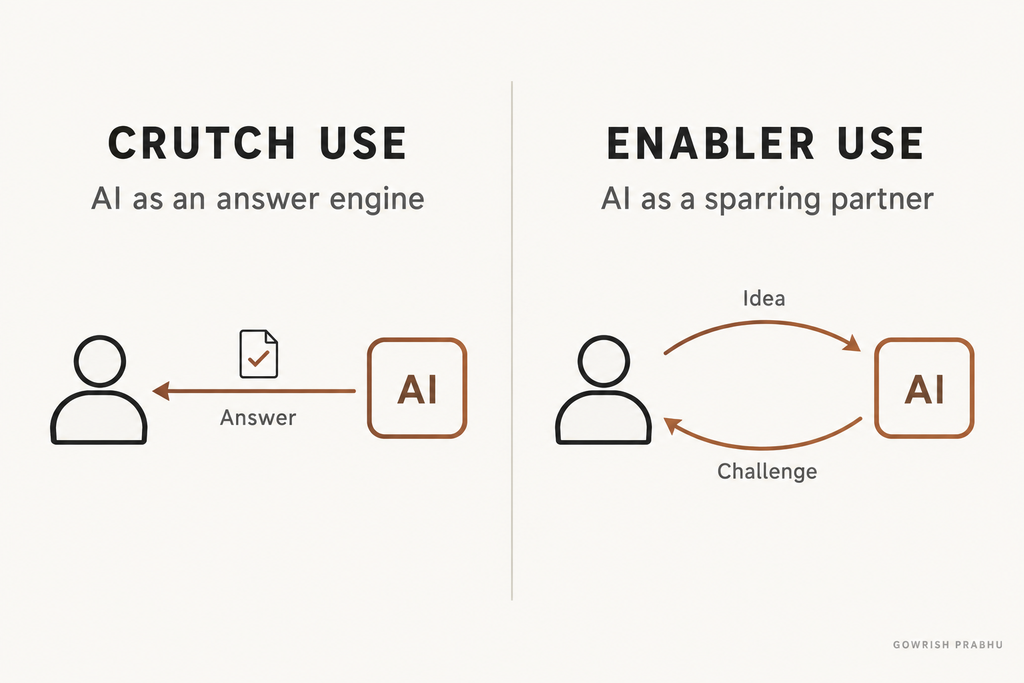
The distinction is not about which tasks are permitted. It is about sequencing and ownership: who forms the first draft of the thinking, and who is doing the harder work of evaluation. A learner who uses AI to pressure-test a market-entry thesis they built themselves is exercising judgment. A learner who asks AI to build the thesis is outsourcing the one skill the exercise existed to develop.
What this means for how programmes should respond
This has direct implications for how business schools and corporate learning functions design AI policy, and it is worth being specific rather than aspirational.
Assessment design has to shift toward process, not just output. A written recommendation proves nothing about the reasoning behind it when a model can produce an equally polished one in eight seconds. Oral defence, structured “why” interrogation, and visible-draft requirements — showing the reasoning trail, not just the conclusion — recover the signal that AI has erased from the submitted artifact.
AI literacy needs to be taught as a distinct skill, not assumed as a byproduct of access. The Socratic-tutor research is instructive precisely because the model had to be deliberately configured to teach rather than answer. Left to its default behaviour, it answers. Learners need to be explicitly taught to prompt for challenge rather than resolution — an artificial adversary, not an artificial associate — and faculty need to model that use in the classroom rather than leaving it to individual discovery.
Programmes should be honest with participants about the trade they are making. The Microsoft finding on workplace overreliance is the sharpest warning available: the skill atrophy from crutch use does not announce itself in the moment. It shows up later, under pressure, when the model is not in the room. Executive learners in particular — paying a premium for judgment-building, not credential-collecting — deserve to be told this plainly rather than have it discovered the hard way.
The so-what
The debate over GenAI in education has largely been framed as permit-or-restrict, and that framing is close to useless. The evidence does not support banning the tool; it supports being far more deliberate about which cognitive step in the learning process the tool is allowed to occupy. Used to retrieve the answer, GenAI measurably erodes the exact capability — independent, defensible judgment under ambiguity — that a business education exists to build. Used to interrogate a position the learner has already formed, the same tool measurably strengthens it.
The responsibility here sits with institutions as much as with individual learners. A programme that hands learners a powerful answer engine and no instruction on how to resist using it as one should expect exactly the outcome the research describes. The schools and corporate learning functions that get ahead of this will be the ones that teach the coaching mode explicitly, redesign assessment around reasoning rather than output, and say clearly to their learners: the tool is not the problem, the shortcut is — and we are going to teach you not to take it
Citations:
- Your Brain on ChatGPT: Accumulation of Cognitive Debt When Using an AI Assistant for Essay Writing Task | https://www.media.mit.edu/publications/your-brain-on-chatgpt/ ↩︎
- SBS Swiss Business School — 666-participant survey | https://www.sbs.edu/cscfs/research-and-insights/ ↩︎
- 2025: The Year the Frontier Firm Is Born | https://www.microsoft.com/en-us/worklab/work-trend-index/2025-the-year-the-frontier-firm-is-born ↩︎
- Fakour, H., & Imani, M. (2025). Socratic wisdom in the age of AI: a comparative study of ChatGPT and human tutors in enhancing critical thinking skills. Frontiers in Education, 10, 1528603. | https://www.frontiersin.org/journals/education/articles/10.3389/feduc.2025.1528603/full ↩︎