Two ledgers, kept by two different teams, would reconcile perfectly if anyone actually sat down and ran the reconciliation. Nobody schedules it. Not because the work is hard to do, but because everyone involved has a reasonably good guess at what it would show, and a guess is more comfortable to live with than a confirmed number.
Marketing attribution in most B2B organisations works the same way. The gap between what marketing can claim credit for and what marketing actually influenced is frequently a choice, not a capability limit. The tooling to close it, or most of it, usually already exists. What doesn’t exist is the appetite to run the reconciliation, because an honest model risks showing that credit sits somewhere other than where the current reporting says it does.
Where the Credit Actually Goes
Here is the mechanism, plainly. A piece of thought leadership, generally a well-argued point of view, published under someone’s name, genuinely engaged with by the people who read it, does the work of moving a buyer’s thinking. That buyer doesn’t convert on the spot. Weeks or months later, they enter the tracked pipeline through a different, later touchpoint: a web search or an AI search, a referral, a sales conversation that started from an inbound enquiry with no recorded source. Last touch gets the credit. The piece that actually did the persuading gets none.
This isn’t a measurement bug waiting for a better tool. It’s a structural feature of how most attribution models are built, and it produces a specific, predictable distortion: content and channels with a longer, less traceable path to influence get systematically under-credited relative to channels that sit closer to the moment of conversion. Nobody can ask the buyer here. Perhaps the buyer would not even remember what started their journey, anyway, well that’s true in most cases. But there is no way to ask the buyer. Over time, that distortion doesn’t just misreport the past. It reallocates the next budget away from the things that were actually working.
The closer an activity is to the buying decision, the easier it is to credit.
The earlier it shapes the decision, the more valuable it may be and the harder it is to prove.
Who Has a Reason Not to Look
I want to be precise about what kind of problem this is, because it’s easy to make it sound like someone’s fault. It isn’t, in the way that word usually implies. The channels closest to the point of conversion, i.e., the ones that pick up last-touch credit almost by design and construction, have every incentive to leave the model exactly as it is, because the current model already tells a flattering story about them. Nobody sat in a room and decided to under-credit thought leadership.
Consider another possibility (which in retrospect even I did not think in terms of attribution only did in terms of long tail of organic reach) that happened recently at my organisation. For whatever good reasons that someone in authority convinced the C-level leadership with, about 80% of the pages on our website were purged. A potentially attributable great page that had a long tail of conversion (and at its peak got many a conversion) does not exist today.
The incentive is just quietly built into whichever team’s dashboard already looks good (or was verifiable), and looking good (or easily verifiable) is a comfortable place to stop asking questions. That’s a structural incentive problem, not a personal one, and it’s worth naming that distinction clearly. The fix isn’t finding someone to blame for the gap. It’s recognising that nobody inside the current reporting structure benefits from closing it, which is exactly why it stays open.
The organisation rarely lacks opinions about attribution.
It lacks a measurement system that everyone is willing to be judged by.
Aiming for Honest, Not Perfect
None of this means a fully accurate model is within reach, and it’s worth being direct about that too. A model that captured every point of influence on a genuinely long, multi-stakeholder B2B buying decision would need data most organisations don’t have and some data no organisation can ever fully capture, such as a buyer’s private conversation with a colleague, a piece of content read once and never clicked again from a different device. Chasing perfect attribution is chasing something that doesn’t exist, and it’s a convenient excuse for chasing nothing instead.
The realistic standard is different: a model honest enough to move directional decisions in the right direction, even if it can never assign the exact right percentage to the exact right touchpoint. That’s a lower bar than perfection and a considerably higher bar than what most organisations currently have, which is a model that’s easy to defend and knowingly incomplete in one direction.
Multi-touch attribution can become a more elaborate way of distributing guesses.
The answer is not to reject weighting models.
It is to make the assumptions visible and test whether they improve decisions.
The One Step Worth Taking First
The place to start isn’t a full model rebuild. It’s tracing a small, specific sample of closed deals backward, by hand if necessary, to find the earliest point any record shows the buyer engaging with anything the marketing function produced, including the channels that currently get no credit at all. That single exercise, run honestly on even twenty or thirty deals, tends to surface the distortion clearly enough that it stops being deniable.
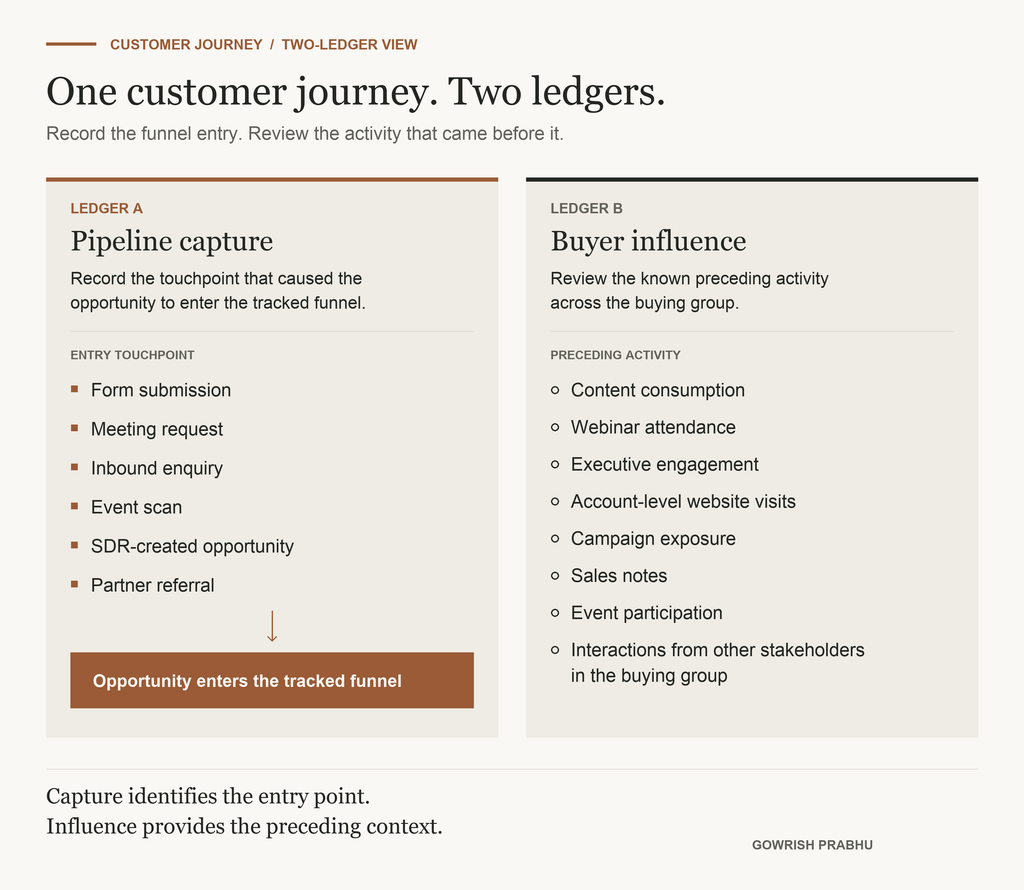
then review the known preceding activity across the buying group.
Ledgers that don’t get reconciled don’t stay quiet forever. Eventually a number comes up that nobody can explain, and the reconciliation happens anyway, under worse conditions and with less patience for what it finds than if someone had chosen to run it on their own terms.